Launching and scaling a localized B2B seller platform from lead generation to paid memberships
October 2022 – March 2024
Overview
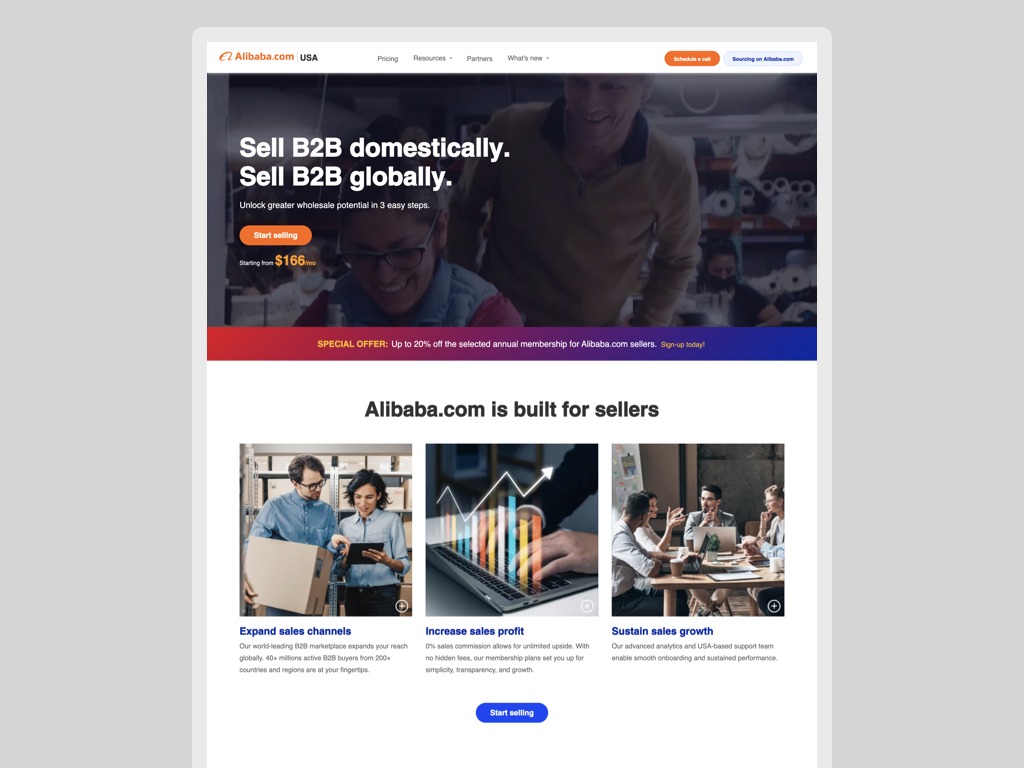
Alibaba.com USA was launched as a dedicated website to acquire, educate, and convert US-based B2B sellers. The project represented a strategic shift for Alibaba.com by introducing a localized experience designed to address trust, brand perception, and usability gaps in the US market.
The site was built from scratch and evolved from an informational and lead-generation platform into a transactional experience where sellers could select plans and complete payment online. I led UX strategy, design, front-end development, content direction, and SEO execution, working closely with marketing, sales, account management, and cross-functional teams across the US and China.
Business Goals
Team priorities were clearly defined and guided all design decisions:
- Drive paid seller memberships
- Increase lead volume and quality
- Grow qualified traffic across organic and owned channels
Key Challenges
1. Trust and credibility: US sellers often perceived Alibaba.com as a platform for overseas suppliers only. Establishing credibility and relevance for US sellers was critical to engagement and conversion.
2. Platform complexity: The seller experience involved multiple steps, products, and concepts that were unfamiliar to new users. The challenge was to simplify onboarding without diluting the value proposition.
3. Transactional flow iteration: The sign-up and payment experience went through several iterations. Early approaches caused significant drop-off due to cross-domain account creation and payment friction. Interim third-party solutions improved completion but required manual follow-up. The final solution streamlined the Alibaba.com flow, reducing friction while preserving data visibility and scalability.
This required close collaboration with engineering, product, sales, and account management teams, supported by continuous performance evaluation.
My Roles and Responsibilities
- UX strategy: Defined end-to-end seller journeys, conversion funnels, and experience principles across lead generation and paid flows.
- Information architecture and user flows: Structured navigation, page hierarchy, onboarding paths, and SSO flows to support clarity, education, and conversion.
- UI, front-end development, and responsive design: Designed and built responsive experiences across desktop, tablet, and mobile, establishing a modern and localized UX standard for Alibaba.com USA.
- Pricing and conversion optimization: Led pricing module design and ongoing funnel optimization from Select plan through checkout to improve CTR and paid conversion.
- SEO and content strategy: Owned SEO strategy and implementation including technical, on-page, and content-driven optimization to support sustainable organic growth.
- Cross-functional leadership: Aligned marketing, sales, account management, and engineering teams around shared goals, timelines, and performance metrics.
Understanding The User
he primary audience was US-based B2B sellers, including small business owners and growing companies exploring wholesale or manufacturing opportunities.
Key user needs:
- Clear proof that Alibaba.com supports US sellers
- Confidence in the value of paid memberships
- Simple and guided onboarding experiences
- Access to education, training, and human support
These insights informed UX decisions, content structure, and the emphasis on seller success stories and educational resources.
Results and Impact
- Achieved 3× growth in average daily unique visitors within six months
- Maintained ~70% of total traffic from non-paid channels, supporting sustainable growth
- Drove 2× growth in SEO traffic through technical and content optimization
- Exceeded the 1% Select Plan CTR target, improving paid conversion
- Successfully transitioned the site from lead generation to a scalable paid membership model
Key Takeaways
This project highlights my ability to lead complex, cross-functional initiatives and connect UX strategy, design execution, and business outcomes. It demonstrates how iterative design, front-end execution, and data-informed decision-making can drive trust, conversion, and long-term growth in a B2B platform.